Outdoor warning sirens are the ones you hear tested at the start of the month and, once in a while, for real. On Friday, October 30, 2026, Bill Boom’s boom truck crane lifted a worn-out siren head off a 50-foot pole at East Alameda Avenue and South Fairmont Drive in Aurora and set the new one in its place. Here is how a siren swap on a live residential street actually goes.
What the job was
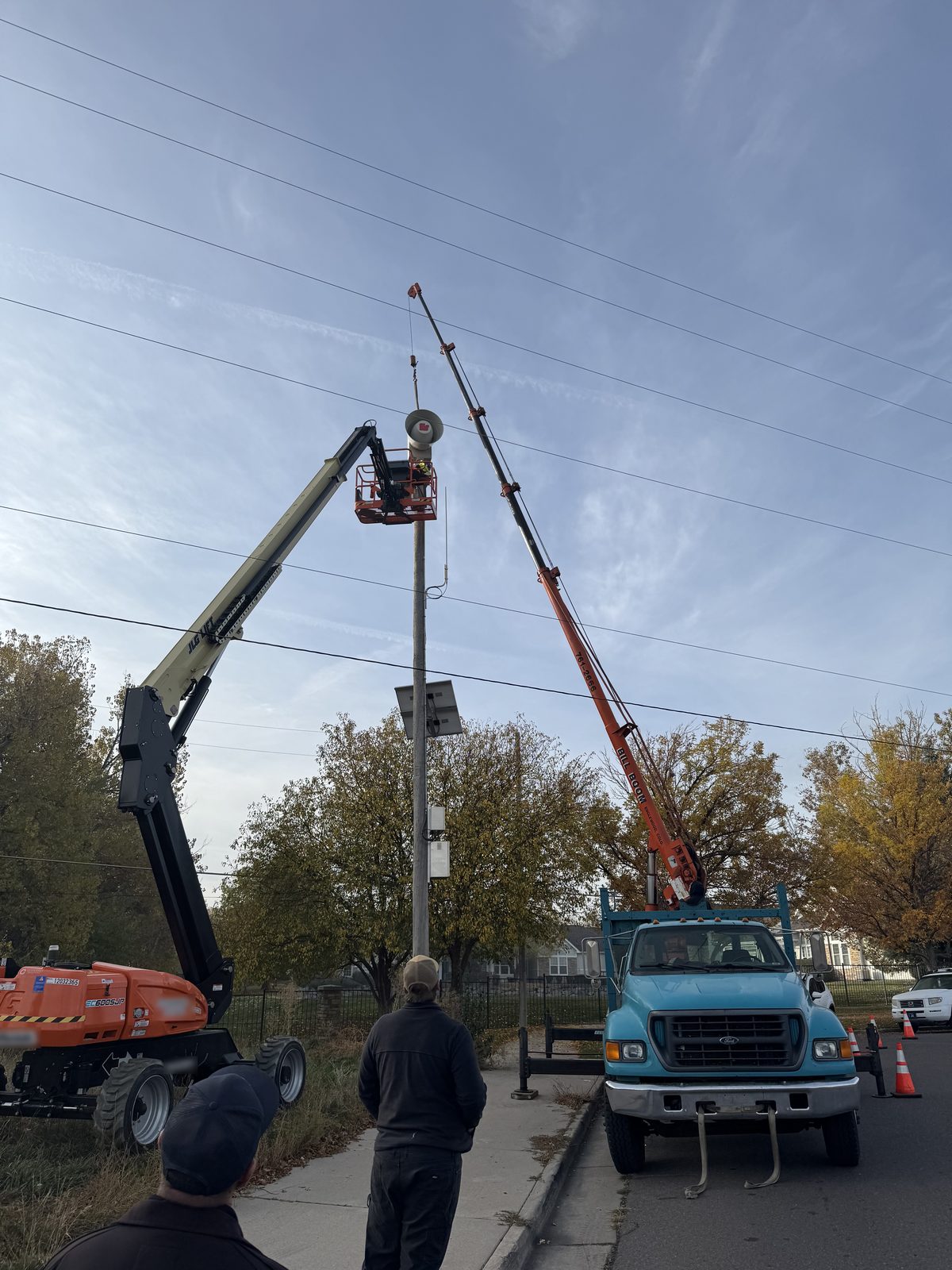
The siren is a Federal Signal head mounted on an existing wood pole in the grass strip between the sidewalk and the curb. The pole stayed. Only the head at the top came down and a new one, about 500 pounds, went up. A public-safety siren contractor handled the wiring and hardware. We handled the lifting.
This is not ordinary equipment. A tornado siren is first-response gear. When one is out of service, the neighborhoods within earshot have a gap in their warning coverage until it is fixed. Getting the new head up, wired, and tested the same day puts that coverage back in place before the next storm season. Our part was small compared to the people who design and maintain these systems, but it is the part that needs a crane, and we were glad to do it.
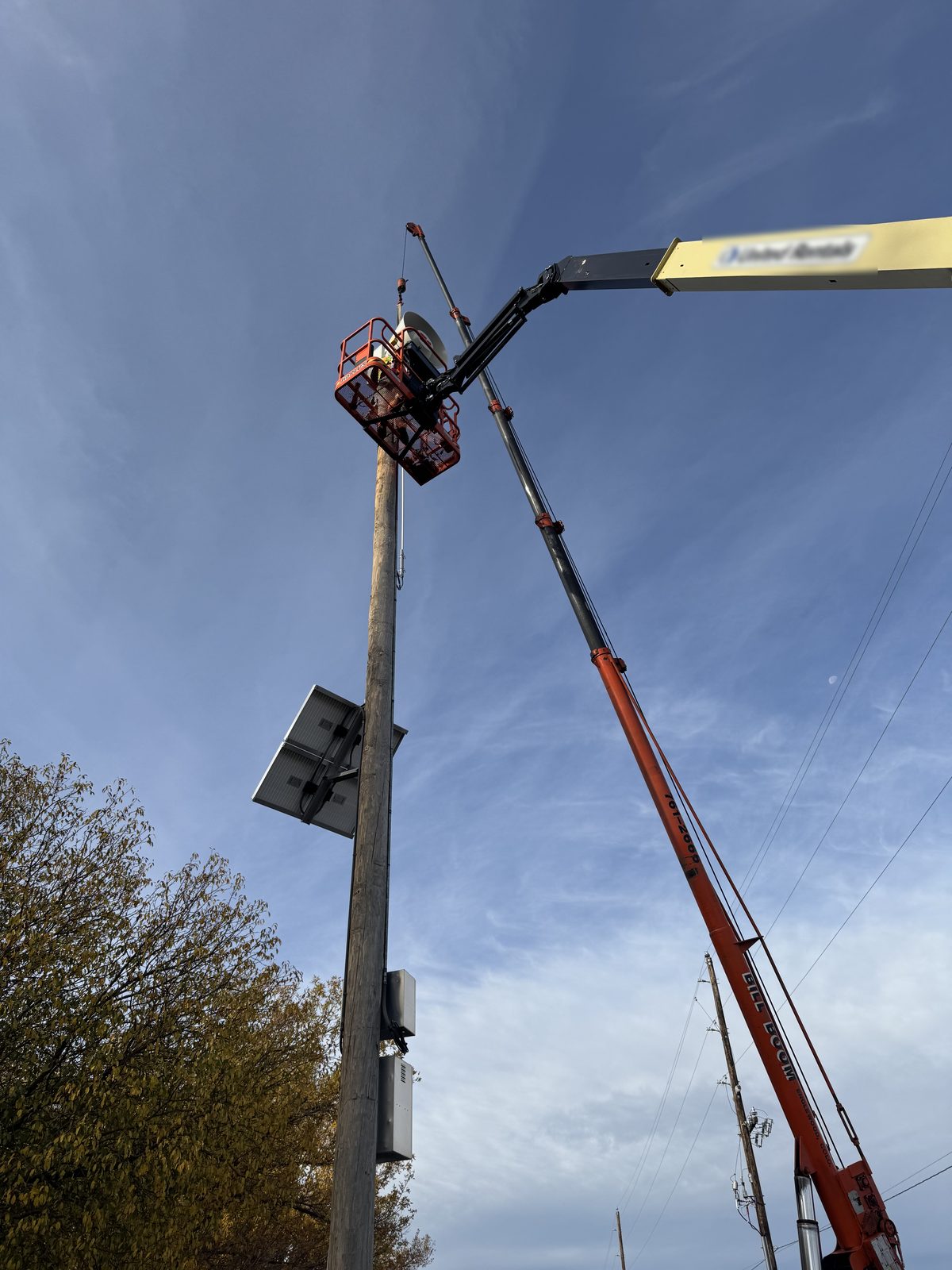
Two machines did the work together. A rented boom lift carried the technician up to the top of the pole, where the bolts and wires are. Our crane did the heavy part: holding the old siren while the technician unbolted it, lowering it to the ground, then raising the new head and holding it steady while it was bolted on. A boom lift basket is not rated to carry a load like that, and a technician cannot hold 500 pounds in place by hand. That is why a crane and a lift both show up for a job like this.
Why a boom truck was the right crane
A siren pole sits on a neighborhood street, not a construction site. There is a sidewalk, a fence, parked cars, and houses on both sides. A boom truck sets up in a parking lane with a few cones and is gone in half a day. A bigger crane would have needed a lane closure and a lot more room for no gain, because the lift itself is light. The reach matters more than the capacity: 50 feet up, plus enough boom to stay clear of the pole and the lift basket.
Working next to power lines
The hard part of this lift was not the weight. It was the overhead power lines running along the same street. Before anything moved, the crane operator and the technician walked the site and agreed on the swing path, the hand signals, where the outriggers would sit, and how far the boom would stay from the wires. Power to the siren itself was shut off at the control cabinet and the batteries disconnected before the technician touched anything. The crane never swung over the sidewalk while anyone was on it. The lift went the way a good lift should: no surprises, old head on the ground, new head bolted on, cones picked up by early afternoon.
This is the kind of planning we do on every lift near utilities, whether it is a siren, a transformer, or a rooftop unit next to a service drop. If your job has wires in the picture, say so when you call and we will plan around them.
Who hires a crane for a siren or pole-top job
- Public-safety and emergency management contractors replacing or installing tornado and outdoor warning sirens
- Utilities and electrical contractors setting equipment on poles
- Cities, counties, and school districts maintaining sirens on their own property
- Telecom and radio crews hanging antennas or cabinets at height
If you are a contractor flying in to do the technical work, we are the local crane. Tell us the pole height, the weight, and the address, and we will tell you what we are bringing.
How to book a crane for a pole-top lift
Call (303) 761-2666. There is no call center. The person who picks up knows the trucks and can tell you on the spot whether a boom truck fits the job. Every lift is quoted on the phone. Bill Boom has been lifting in the Denver metro since 1965, out of our yard in Englewood, and we cover Aurora, Denver, and the rest of the Front Range.
Frequently asked questions
Can a crane lift a tornado siren onto an existing pole?
Yes. The siren head is rigged at its lifting point, raised to the top of the pole, and held in place by the crane while a technician in a boom lift bolts it down. The pole itself usually stays put.
How much room does a boom truck need on a residential street?
Roughly a parking lane plus a little extra for the outriggers. Cones and sidewalk protection are usually enough; a full lane closure is rarely needed for a half-day pole-top lift.
Can you lift near power lines?
Yes, with a plan. We confirm the clearance to the lines, the swing path, and the setup spot with everyone on site before the first pick, and we keep the boom well away from the wires the entire time.